Friday, 27 September 2013

Italian


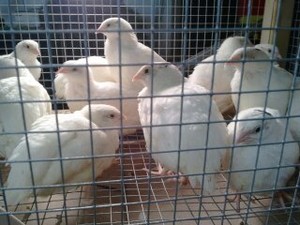
They are just a color variety of the Coturnix. Same productivity as any other Coturnix. Some are large and some are small. Selective breeding takes place to get your jumbos or XL. I have these at home and are my home bred. They are very easy to care and breed. Also the males coo-tuur-nix is very pleasing to ears..

finches


Zebra Prices
Pedigree Software
Links
Contents

Zebra Finch Care


Basic Care Zebra finches are fun and easy to have in your home.  They are a pleasure to view and their soft chirping is soothing.  Whether you want only one pair to keep you company or you want to be a breeder with many birds, Zebras are a joy.
Zebra Finches originate from Australia. Zebras live in open grasslands with some bushes and trees.  They live in dry areas over most of Australia.  They live in groups and eat mostly grass seeds.  They build their nests in bushes out of grass, straw, feathers and anything else they can find.  They lay 3-6 eggs and both parents participate in raising the young.  The currently accepted taxonomic nomenclature for the Zebra is "Taeniopygia guttata castanotis".
Zebra finches live to be 4-8 years of age.  I have heard of birds living to 10 and 12 years old, but I think this is rare.
Males: The normal male bird has a gray upper body and wings.  The belly is white.  The beak and legs are a red-orange color.  On each side of the head is a cheek patch.  There is a 'tear drop' mark under the eye.  This is a brown/tan/fawn color commonly called orange.  The flanks/sides of the bird just below the wings, is a chestnut (orange) colored area with white dots.  The chest is black and white stripped like a zebra, hence the name zebra finch.  A truly beautiful bird!
Females: The female also has a gray upper body and wings with a white belly.  The beak and legs are the same red-orange color but not as deep color, lighter.  She has a black 'tear drop' mark under the eye.  The most noticable differences between males and females are the cheek patches and the chest striping.
Let’s talk about some of the aspects of keeping Zebra finches.
   1) Selecting Birds
   2) Location/Environment
   3) Diet
   4) Care
   5) Housing
   6) How do I catch a bird?
   7) Breeding
   8) Colors
   9) Terms

Thursday, 26 September 2013

reading cat's mind


This is not like a big blog but I am damn sure that this blog is a treat for those cat lovers. These images will help judge you to judge what is in a cat's mind. From the way of its tale you can read Its mind.

the beauty of coturnix

Texas A and M Quail are a large breed. They are the result of selectively bred quail, and are bred especially for meat production. Texas A&M quail produce a light skinned, light meat quail. It takes 8 weeks to bring them to butcher weight, which is about 10-14 oz birds.
Selectively bred by A & M Texas college for their white meat and pure white feathers.

breeding your cockatiel parakeet

Breeding your Cockatiel Parakeets:
Cockatiel BreedingBreeding cockatiels:- Breeding cockatiels is not a very difficult task but it requires a lot of time and care. Cockatiels can breed two to three times a year. The pairs like to live in a random cage but its OK to keep them in an avairy. Necessary conditions are light and proper items in cage.
Pet or Breeder:- One should be known to the fact first that the bird can be human's or bird's. The parakeet can either bond with a human and be pet or bond to suitable mate to breed. So a bird can be pet or a breeder, not both at timeLutino Pearl Cockatiel with chicks.
Breeding maturity:- Cockatiels can breed at the age of 9 to 12 months but breeding maturity is attained at the age of 15 to 20 months. Breeders usualy bond a young one with an old one so they can learn and teach.Cockatiel Chick
True pairs:- One should be known that males there will be no eggs while in females there will be many of them but unfertilecockatiels having same sex can bond but can't breed. In True pairs:- One should be known that males there will be no eggs while in females there will be many of them but unfertile.
In eno and pied cockatiels or the simple ones, the female has a lining pattern on the under side of its tale feather.

Wednesday, 25 September 2013

Patridge(our national bird in Pakistan @chakor)

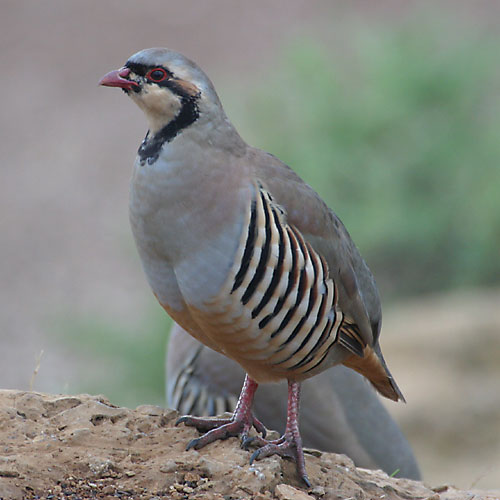
Partridges are birds in the pheasant family, Phasianidae. They are a non-migratory Old World group.
These are medium-sized birds, intermediate between the larger pheasants and the smaller quails. Partridges are native to Europe, Asia, Africa, and the Middle East. Partridges are ground-nesting seed-eaters.[citation needed]
According to Greek legend, the first partridge appeared when Daedalus threw his nephew, Perdix, off the sacred hill of Minerva in a fit of jealous rage. Supposedly mindful of his fall, the bird does not build its nest in the trees, nor take lofty flights and avoids high places.[1]
Partridges appear as part of the first gift listed in the Christmas carol, "The 12 Days of Christmas". As such, "A partridge in a pear tree" is sung as the last line of each chorus.

Aggressive dog(pitbull)


Discription:The Pit Bull immediately strikes one as being a dog of power, passion and undying willingness. The brick-like head, which is especially broad between the cheeks (to house the powerful jaws), is carried upon a thickly muscled, well-defined neck. The neck runs into a deep, thick, well-sprung chest. The American Pit Bull is a very muscular, stocky, yet agile dog that is extremely strong for his size. The ears are generally cropped, though this is optional. Docked tails are not accepted by the UKC or the ADBA. The eyes are round. Both the ADBA and the UKC do not accept blue eyes or the coat color merle. The American Pitbull Registry does accept a merle coat. The teeth should form a scissors bite. Its coat is made up of thick, short, shiny hair. All colors are admissible. The tail tapers to a point.
  Height, weight
The American Pit Bull Terrier is both powerful and agile. Actual weight and height are less important than the correct proportion of weight to height.
 Height: 14 - 24 inches (35 - 60 cm)
Weight: 22 - 78 pounds (10 - 35 kg
)

A very common misconception is that APBTs are muscle-bound hulks that weigh in around 85 pounds (39 kg) or more and this is generally not the majority. Most of the APBT's that are that large have been crossed with other breeds and are being called American Bullies. The general public often gets American Bullies mixed up with the American Pitbull Terriers. American Pitbull Terrier vs. American Bully